Agents & engineering
AI coding, agentic workflows and the path from prototype to a maintained service.

Three starting points
Agentic engineering as a discipline
Examine how agent skills, tests and human responsibility fit together.
02 · Technical material · AI AlliancenAgent Harness · reference architecture
Explore the working proposal for controls outside the agent.
Building effective agents
Understand the distinction between predefined workflows and agents.
All material in this track
Find the right material
Search the knowledge library
315 entries across experience, guides, presentations, resources and AI terms. Search the entire collection, including material not shown on this page.
1–6 of 107 results
Vibe coding with a production gate
Vibe coding can shorten the route from need to prototype, but responsibility for software in operation remains unchanged. GitHub recommends checking function, context, security, maintainability and dependencies, supported by automated tests and human review. A responsible municipal model therefore gives low-risk prototypes an isolated experimentation track, followed by a clear production gate. Otherwise, the maintenance burden and technical debt appear only after the impressive demonstration.
Open materialAgentic engineering as a discipline
A coding agent can inspect a repository, make a plan, change several files and run tests, documentation and review tools. This makes agentic engineering more than code generation. Versioned Agent Skills and repository instructions can make organisational standards repeatable, but people still own the process: acceptance criteria, bounded implementation, automated controls, independent review and approved release.
Open materialClaude Code, security and AI-assisted interpreting
Claude Code can access files, commands and external tools. A security assessment must therefore cover permissions and data flows, not only the model. For AI-assisted interpreting in schools and early-years settings, a lawful basis for processing does not come with the product. The authority must document purpose, necessity, proportionality and legal basis; children’s data require especially strict data minimisation and risk controls.
Open materialAgent Harness: control outside the model
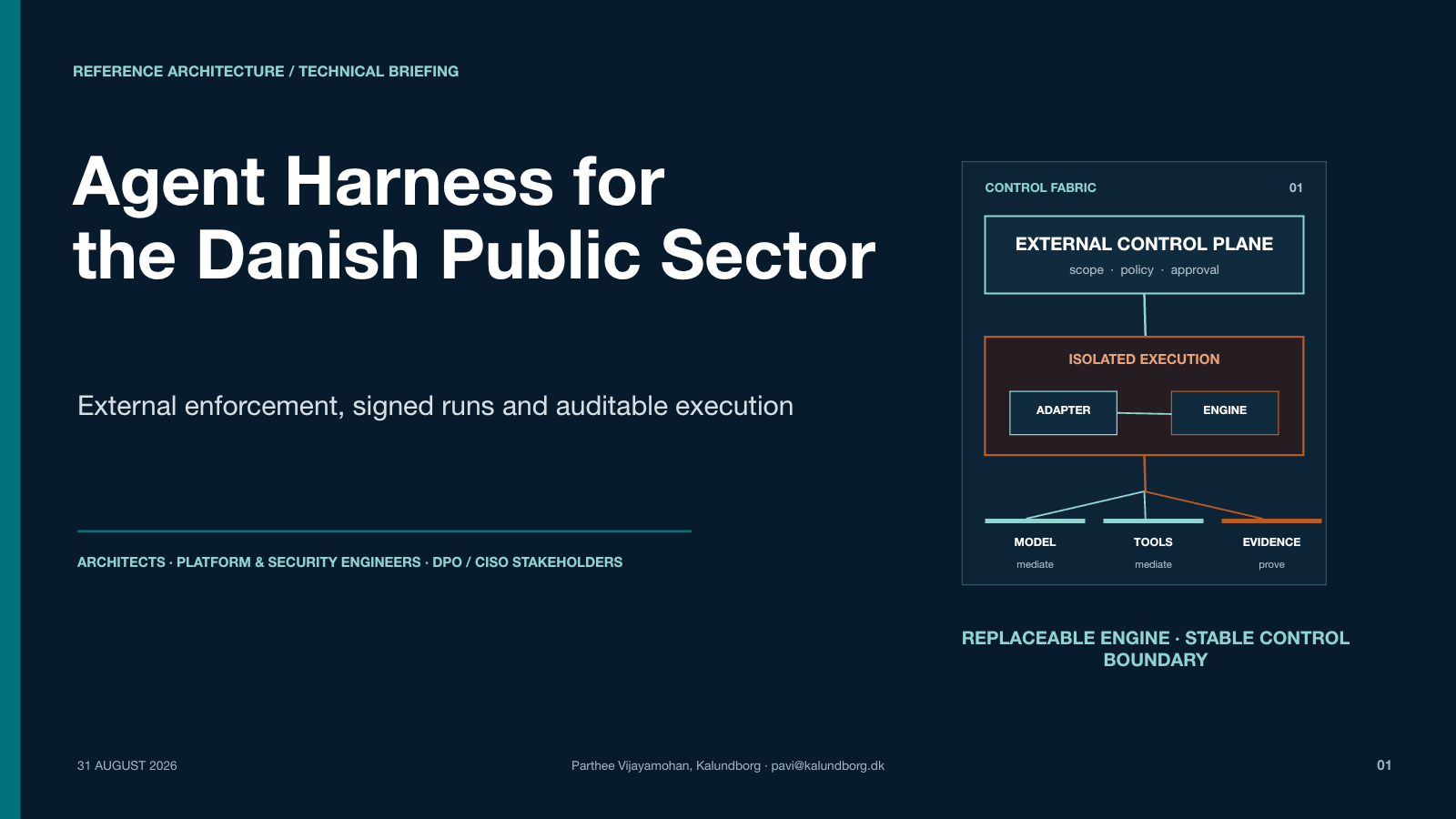
Agent Harness moves enforcement out of the model and into a shared, vendor-neutral control framework. The proposal is not an adopted standard; the model must not itself be the security enforcement point. A signed execution manifest binds identity, purpose, data, versions, tools, network access and approvals. Execution is isolated, while access to models, tools, secrets and networks passes through external gateways using deny-by-default and least privilege.
Open materialBuilding effective agents
A clear-eyed explanation of the difference between workflows and agents, when complexity helps and why feedback loops are essential.
Read original sourceFrom AI-generated code to controlled development and operations
NIST describes how AI-generated requirements, code and configuration can be traced and undergo review, security testing and accountable approval. Use it to discuss operating requirements for vibecoding and small municipal applications. The demonstration uses human-directed generative AI; agentic development is a future phase. The guidance is evolving, not evidence of municipal impact or a Danish approval.
Read original sourceTopic matches help you navigate; they are not recommendations. Read the original material and check its date, context and scope.
Add a question or perspective